
Every business owner hits a wall sooner or later. Enquiries slow down. Ad spend goes up while calls go down. A good customer leaves, a supplier delays an order, or the website that looked great at launch suddenly stops bringing in business.
The problem itself is rarely what hurts the most. What hurts is the reaction: panic, changing five things at once, and then having no idea which change worked. A calm, repeatable method fixes that.
In this guide you will learn a simple 7-step framework to solve almost any business problem. After that, we apply it to the most common growth and marketing issues Indian business owners face, with practical fixes you can start this week.
Why Most Business Problems Stay Unsolved
Before the framework, it helps to understand why problems drag on for months. In most small and mid-sized businesses, three things go wrong.
1. People treat symptoms, not causes. Sales drop, so the owner cuts prices. But the real cause may be that the website stopped appearing on Google, so fewer people are finding the business at all. A discount does not fix that.
2. Decisions are made on feeling, not facts. "I think Instagram is not working" is an opinion. "Instagram brought 4 enquiries last month against 11 from Google" is a fact you can act on.
3. Nobody owns the problem. If everyone is responsible, no one is. Problems without a name and a deadline quietly become permanent.
The framework below is designed to remove all three.
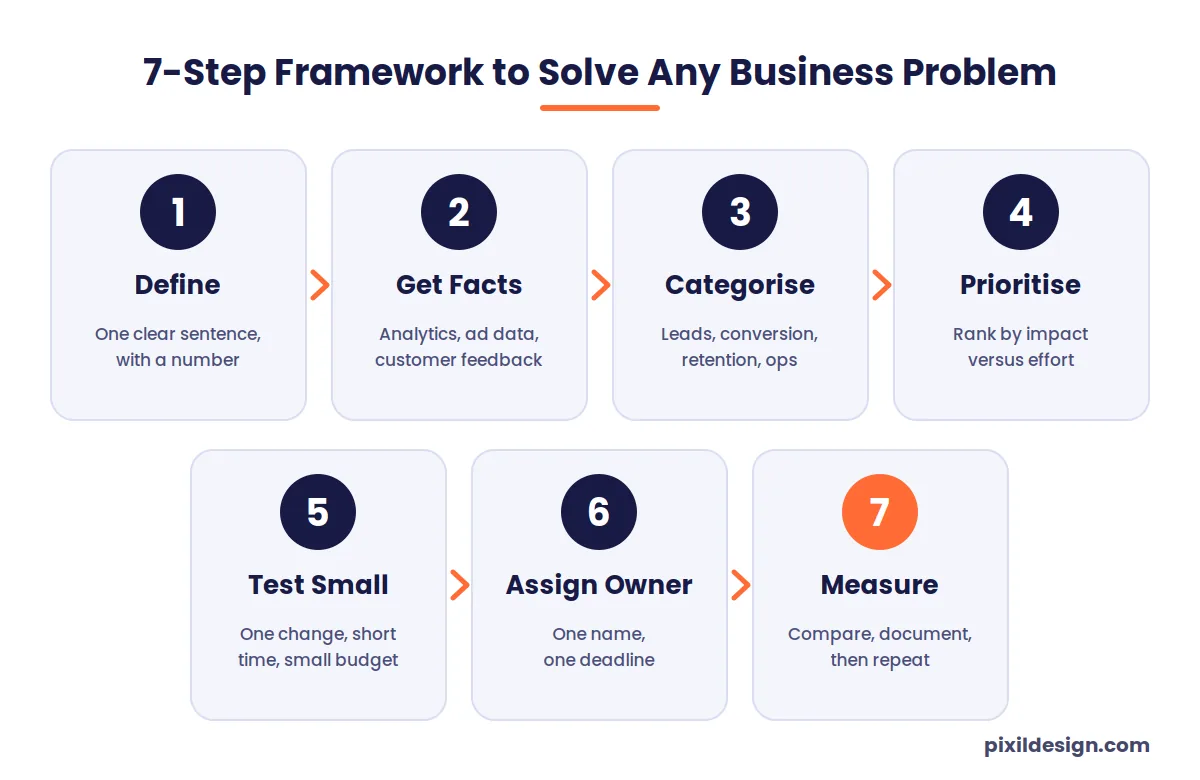
The 7-Step Framework to Solve Any Business Problem
Step 1: Define the Problem in One Clear Sentence
Write the problem down in a single sentence, with a number if possible. Compare these two:
- Vague: "Business is slow."
- Clear: "Website enquiries fell from 40 a month to 18 over the last 60 days."
The second version tells you where to look and lets you measure improvement later. If you cannot state the problem in one sentence, you do not understand it yet, and that is your first task.
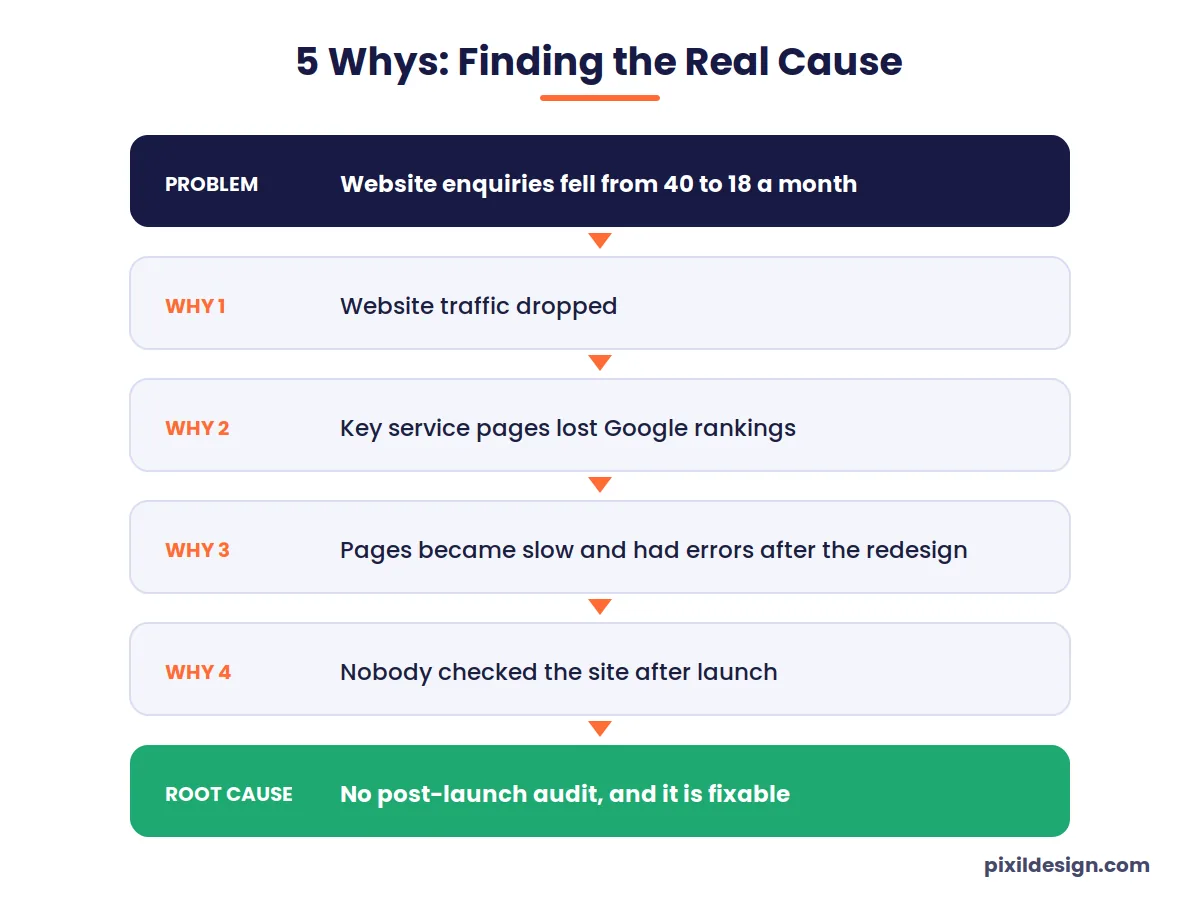
Then go one level deeper with the 5 Whys technique. Keep asking "why" until you reach something you can actually change:
- We are getting fewer enquiries. Why? Website traffic dropped.
- Why did traffic drop? Our main service pages lost Google rankings.
- Why did they lose rankings? The pages became slow and had errors after the redesign.
- Why were the errors not caught? Nobody checked the site after launch.
The root cause is not "bad luck" or "competition." It is a missing post-launch check, and that is fixable.
Step 2: Collect Facts Before You Form Opinions
Open your data before you open a debate. Useful sources include:
- Google Analytics 4 for traffic, sources and conversions
- Google Search Console for search visibility and page errors
- Your ad dashboards for spend, clicks and cost per lead
- A simple enquiry log (phone, WhatsApp, forms) with the source of each lead
- Direct customer feedback, including why people did not buy
If you cannot trust your numbers, the first fix is the measurement itself. Many businesses discover that their forms, calls or purchases are not tracked correctly, so they are making decisions in the dark. Proper GA4 and Google Tag Manager setup makes sure every enquiry is tied to the channel that produced it.
Step 3: Place the Problem in the Right Category
Most business problems fall into one of six buckets. Knowing the bucket tells you who should solve it and what tools to use.
- Lead generation: not enough people are discovering you.
- Conversion: people visit or enquire but do not buy.
- Retention: customers buy once and never return.
- Operations: delivery, quality or process breakdowns.
- Cash flow: money comes in too slowly or goes out too fast.
- People: hiring, skills, motivation or communication gaps.
It is common for a problem to look like one category and actually belong to another. Low sales (conversion) can really be a lead quality issue caused by the wrong ad targeting. Sort it honestly.
Step 4: List Options and Prioritise by Impact and Effort
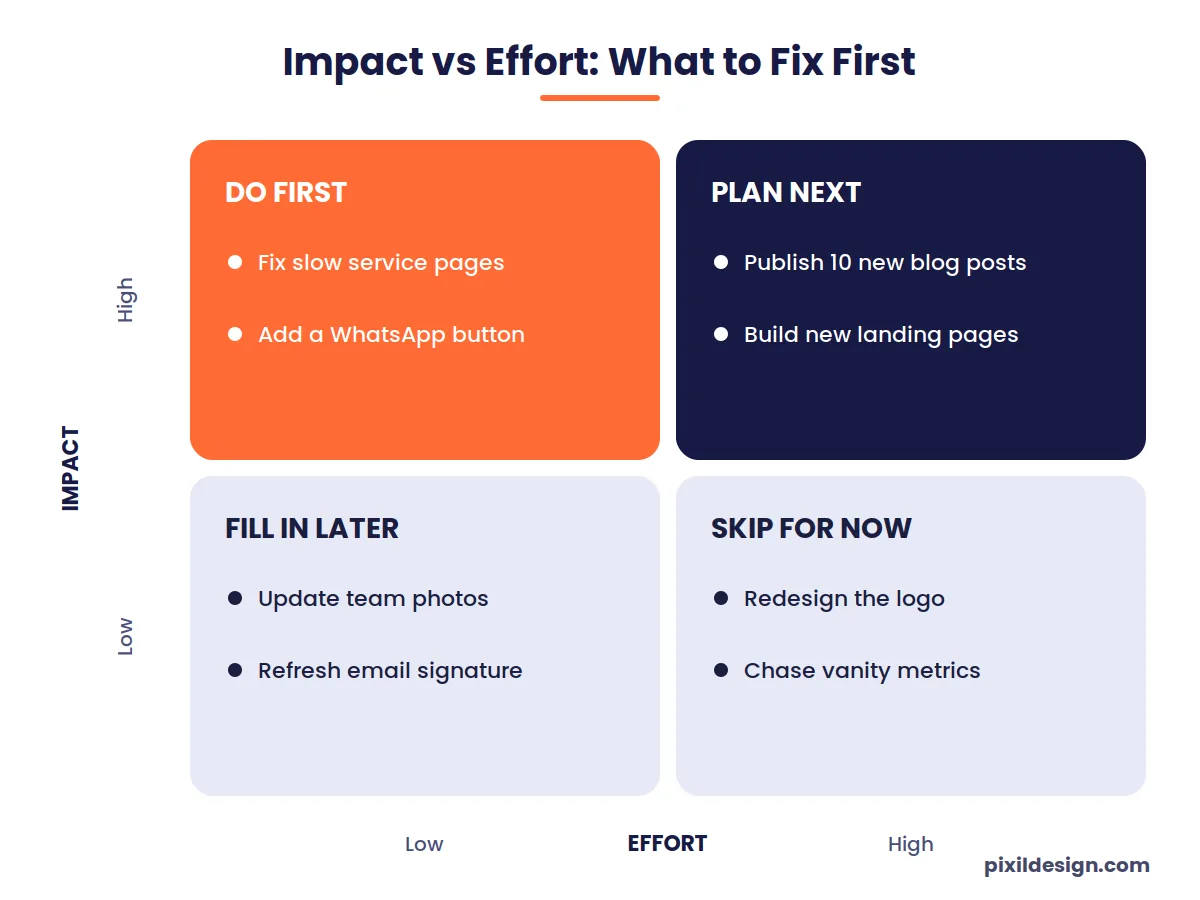
Now brainstorm every reasonable fix, then rank them. A simple impact versus effort table works well:
Option Impact Effort
Fix slow-loading service pages High Low
Write 10 new blog posts High High
Redesign the logo Low Medium
Add a WhatsApp button on key pages Medium Low
Start with high-impact, low-effort items. They build momentum and often solve a large part of the problem on their own.
Step 5: Test Small Before You Commit Big
Before spending lakhs or rebuilding everything, run a small test. Change one thing, for a limited time, on a limited budget, and measure the result.
For example, if you suspect your landing page is the issue, test a new headline and button on one page for two weeks instead of rebuilding the entire website. Small tests are cheap, quick and teach you what your customers actually respond to.
Step 6: Assign an Owner and a Deadline
Every action needs one person's name and one date. "We should improve our Google listing" is a wish. "Rahul updates the Google Business Profile photos and services by Friday" is a plan.
Keep the list short. Three to five actions per week is far more effective than twenty actions nobody finishes.
Step 7: Measure, Document and Repeat
After the test period, compare the result against the number you wrote in Step 1. Did enquiries rise? Did cost per lead fall? Write down what you tried, what happened and what you will do next.
This documentation becomes your business playbook. The next time a similar problem appears, you will solve it in days instead of months.
Common Business Problems and How to Solve Them
Now let us apply the framework to the issues business owners ask about most often.
1. My Website Gets Visitors but No Enquiries
This is a conversion problem, and it usually comes from a short list of causes: slow loading, unclear offer, buried contact details, a long form, or a site that is hard to use on mobile.
How to fix it:
- Check mobile speed first, since most visitors arrive on phones.
- Make your main service and one clear action visible without scrolling.
- Put a phone number, WhatsApp link and short form on every key page.
- Add proof such as reviews, client names and real photos.
A structured website audit and fix reviews speed, crawl errors and on-page issues and gives you a written list of what to repair first. If the site itself needs new landing pages or a speed rebuild, WordPress and Shopify development can handle it.
2. My Business Does Not Show Up on Google
This is a lead generation problem. If customers search for what you sell and never see you, someone else gets that business.
Typical causes are technical errors that stop Google from reading your pages, thin content that does not answer what people search for, and no pages targeting the services and cities you care about.
How to fix it:
- Check that your key pages are indexed in Google Search Console.
- Create one dedicated page per core service, written for the questions customers ask.
- Use clear titles and descriptions that match search intent.
- Publish helpful blog content consistently and link related pages together.
SEO takes patience. A realistic timeline is three to six months to see a clear change, but the traffic it brings tends to keep compounding. Our SEO services focus on fixing what blocks Google first and then building content people genuinely search for.
3. I Am Spending on Google Ads but Not Getting Good Leads
This is one of the most expensive problems because money leaves every day. The causes are usually one of these: broad keywords that attract the wrong people, no negative keywords, a landing page that does not match the ad, or broken conversion tracking.
How to fix it:
- Confirm that calls and form submissions are tracked correctly.
- Review the search terms report and block irrelevant searches.
- Match each ad group to a specific landing page.
- Judge campaigns on cost per qualified lead, not on clicks.
Professional Google Ads management concentrates your budget on people who are ready to buy or call. If you also run Facebook and Instagram campaigns, the same discipline applies to Meta Ads, where creative tires quickly and needs regular testing and replacement.
4. My Social Media Is Active but Brings No Business
Posting regularly is not the same as generating customers. If your page has likes but no enquiries, the content probably talks about the brand instead of the customer's problem, and there is no clear next step.
How to fix it:
- Plan a month of content around your products, offers, festivals and customer questions.
- Write captions the way you would speak to a customer in your shop.
- Add a clear action to posts: message us, call, or visit the link.
- Reply to comments and direct messages quickly, because slow replies lose warm leads.
If consistency is the real obstacle, social media management takes over the calendar, designs, posting and replies so your pages stay active without eating your evenings.
5. I Sell to Other Businesses and Cannot Reach Decision Makers
B2B sales have a different challenge: you need the right job title, not just the right interest. Broad advertising wastes money on people who cannot buy.
How to fix it:
- Define the exact roles you want to reach, such as founders, procurement heads or HR managers.
- Offer something useful, like a guide or audit, instead of a hard sales pitch.
- Follow up consistently, since B2B decisions take time.
LinkedIn Ads let you target by job title, industry and company size, which is why they suit B2B teams so well.
6. My Online Store or Marketplace Sales Are Falling
Falling store sales can come from weak listings, poor product images, price pressure, stock issues or inefficient ad spend. Look at where in the journey people drop off: search, product page, cart or checkout.
How to fix it:
- Improve titles, images and descriptions on your top-selling products first.
- Check ratings, stock levels and delivery promises.
- Review advertising cost against actual sales, not just impressions.
If you sell on Amazon or Flipkart, dedicated marketplace management keeps listings and ads optimised while you focus on products and fulfilment.
7. I Do Not Know Which Marketing Channel Is Working
This problem hides behind all the others. If you cannot say which channel produced your last ten customers, you cannot decide where to put your next rupee.
How to fix it:
- Ask every new customer how they found you and record it.
- Set up conversion tracking for calls, forms and purchases.
- Review one simple dashboard on a fixed day every week or two weeks.
When channels are planned around one shared goal, results improve. That is the idea behind performance marketing, where paid channels work together toward leads or sales rather than separate vanity numbers.
Common Mistakes to Avoid When Solving Business Problems
- Changing too many things at once. You will never know what worked.
- Quitting too early. Some fixes, especially SEO, need months to show their full effect.
- Copying competitors blindly. Their audience, budget and goals may be different from yours.
- Ignoring customer feedback. Your customers often name the problem before your dashboard does.
- Skipping documentation. Without notes, you repeat the same mistakes.
- Avoiding the numbers. Uncomfortable data is still the most useful data you have.
When Should You Bring in Outside Help?
You do not need an expert for every problem. But consider outside support when:
- The problem needs a skill your team does not have, such as technical SEO or ad optimisation.
- You have tried fixing it yourself for two or three months without clear progress.
- Marketing tasks are taking time away from running the business.
- You need an honest second opinion on what is actually broken.
A good partner explains what they did and what it brought in, in plain language, and does not lock you into long contracts. You can see examples of real work in the Pixil Design portfolio and read what clients say on the testimonials page. To learn more about who we are, visit the About Pixil Design page.
Frequently Asked Questions
What is the first step to solving a business problem?
Define the problem clearly in one sentence, ideally with a number attached. A precise problem statement tells you where to look and gives you a benchmark for measuring improvement.
How do I find the root cause of a business problem?
Use the 5 Whys technique: keep asking why the problem happened until you reach a cause you can directly act on. Back every answer with data from analytics, ad dashboards or customer feedback rather than assumptions.
How long does it take to see results after fixing a marketing problem?
It depends on the channel. Paid ads can bring enquiries within the first two weeks once tracking is verified, while SEO usually takes three to six months to show a clear change.
Should small businesses hire an agency or fix problems in-house?
Handle simple, well-understood tasks in-house. Bring in an agency when the work needs specialist skills, ongoing time, or an objective outside view. Many owners find a mix works best.
Why am I not getting leads from my website?
The usual reasons are poor Google visibility, a slow or confusing website, an unclear offer, or broken tracking. A website audit is the quickest way to find out which one applies to you. For more answers, see our FAQ page.
Final Thoughts
Business problems are not a sign that something is wrong with you. They are a normal part of growth. What separates businesses that stall from businesses that grow is not the absence of problems but a reliable method for solving them.
Define the problem clearly, check the facts, find the real cause, test a small fix, assign an owner, and measure the result. Repeat that cycle and every problem becomes smaller than the last one.
If your current challenge is getting more enquiries, fixing wasted ad spend or showing up on Google, we are happy to take a look.
Need help finding what is holding your business back? Book a free consultation with Pixil Design and share your website or Instagram page. A real person from our Jaipur team will reply within a working day with what we would look at first. You can also browse more guides on our marketing blog.
Want results like this for your business?
Talk to the Pixil Design team — we will review your current setup and suggest the fastest wins.
Get a Free Consultation